

An EPS CNC cutting machine is the better choice for changing contours, short batches and shapes imported from CAD; a multi-wire cutting line is the better choice for repeating flat sheets at high volume. On ChinaEps configurations, CNC positioning is ±0.1 mm at 50–500 mm/min, while the SPB multi-wire line cuts at 1–1.5 m/min with up to 60 wires and ±0.3 mm sheet-thickness tolerance. The product mix, not the smaller tolerance number, should decide the purchase.
Both machines use heated resistance wire, but they solve different factory bottlenecks. CNC moves one wire or a small wire set along a programmed contour. A multi-wire line moves a block through a bank of parallel wires so dozens of sheets are created in the same pass. Comparing them as if one were simply the “more accurate” version of the other leads to an expensive mismatch.
Decision in 30 Seconds
| If most paid orders are... | Choose | Why |
|---|---|---|
| Insulation boards, sandwich-panel cores or standard packaging sheets | Multi-wire line | Up to 60 wires cut many equal thicknesses at once; automatic feed keeps block flow continuous. |
| Cornices, letters, tapers, packaging cavities or patterns that change by order | CNC cutter | DXF/G-code changes the path without mechanically resetting a full wire bank. |
| At least 70% standard sheets, plus a recurring custom-profile business | One of each | The line protects sheet throughput while CNC handles the higher-mix jobs without stopping it. |
| Flat products in many thicknesses, but no curved profiles | Multi-wire line with automatic wire setting | A 2–4 minute 60-wire setup addresses thickness changeover without paying for contour capability. |
Soft check before requesting prices: classify the last 50 paid orders by geometry, batch size and changeovers. If the drawings are mostly rectangles, start with the multi-wire EPS block cutting line. If every order carries a different profile file, start with the CNC hot-wire foam cutter.
What Each Machine Actually Does
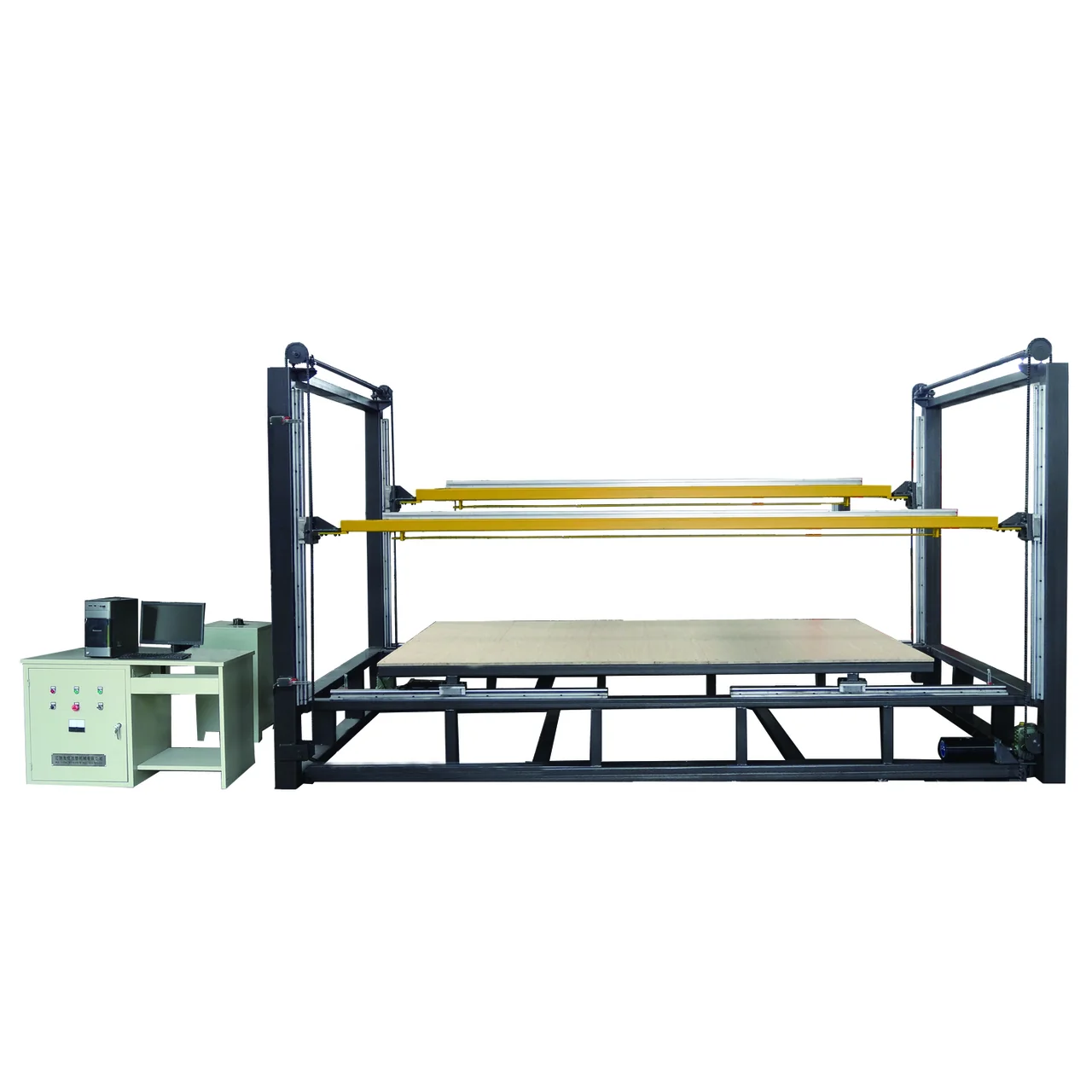
An EPS CNC cutting machine converts a digital contour into coordinated axis motion. The ChinaEps configuration uses servo motors and ball screws on three or four axes, accepts DXF or G-code and previews the path on the HMI. Its qualified envelope is 2,000–4,000 mm X travel, 1,000–2,000 mm Y travel and 500–1,200 mm Z travel, depending on the ordered frame.
A multi-wire cutting line converts one molded block into many parallel sheets and trimmed dimensions. The SPB premium configuration accepts 2,000–6,000 mm-long blocks up to 1,260 mm wide and high. A robotic head positions as many as 60 wires in 2–4 minutes, then the conveyor and cutting frames repeat the same geometry over successive blocks.

Head-to-Head Specification Comparison
| Selection factor | EPS CNC cutting machine | SPB multi-wire cutting line | Procurement consequence |
|---|---|---|---|
| Primary output | 2D contours and limited 3D tapers | Flat sheets, side trim and length cuts | Choose by saleable geometry, not controller label. |
| Motion | 3–4 servo axes; digital toolpath | Block conveyor plus horizontal, vertical and cross-cut frames | CNC changes in software; multi-wire changes wire spacing. |
| Configured speed | 50–500 mm/min, contour-dependent | 1–1.5 m/min on 30 kg/m³ EPS | Line speed is 2–30 times higher before counting simultaneous wires. |
| Working precision | ±0.1 mm positioning; ±0.05 mm repeatability | ±0.3 mm finished-sheet thickness tolerance | These values measure different things and are not interchangeable. |
| Minimum feature | 5 mm inside radius with 0.3 mm wire | 10 mm horizontal sheet thickness; straight cuts | CNC earns its place when radius and contour create customer value. |
| Wire system | Usually one wire or a small set, 0.3–0.5 mm | Up to 60 automatically positioned wires, 0.4–0.7 mm | Parallel output dominates sheet economics. |
| Installed power | 6–10 kW, depending on size | 32 kW heating plus 11 kW motor power | Compare kWh per saleable unit, not connected load alone. |
| Changeover | Load and verify another DXF/G-code file | Reset wire spacing; automatic setup takes 2–4 minutes | Frequent shape change favours CNC; thickness change alone does not. |
| Material envelope | EPS, EPP, XPS and suitable PU foam, 12–45 kg/m³ | EPS, including graphite and FR grades, 12–45 kg/m³ | Validate every grade with a full-size trial. |
The apparent precision advantage needs careful reading. CNC positioning describes where the axes can place the wire. Finished-profile tolerance also depends on wire bow, thermal kerf, foam density, block stability and path speed. Multi-wire ±0.3 mm is a sheet-thickness result from a mechanically different process. Put the finished-part drawing and measurement method into the factory acceptance test.
Throughput: Why Wire Count Changes the Economics
A multi-wire line does not merely travel faster; it creates many cuts simultaneously. At a 1.2 m/min conveyor speed with 40 active horizontal wires, the block advances 72 metres in one hour while all 40 sheet boundaries are cut together. CNC at 300 mm/min travels 18 metres of toolpath in the same hour, before direction changes and loading time. Those figures are motion references, not finished-output promises, but they expose the scale difference.
CNC output must be estimated from total toolpath length per part. A 6 m perimeter at 300 mm/min requires about 20 minutes of cutting before loading, file verification and any second pass. Multi-wire output is estimated from block length, conveyor speed, wire layout, loading and downstream packing. A vendor quoting only “pieces per hour” without the test drawing, density and active-wire count has not defined the result.
For the heat/feed relationship behind both machines, use the EPS hot-wire temperature and speed guide. It explains why a recipe proven with ten wires is not automatically proven with sixty.
Changeover: Shape Changes and Thickness Changes Are Not the Same
CNC wins when the contour changes; automatic multi-wire wins when only sheet thickness changes. A CNC operator imports a new file, checks scale, origin, lead-in and path direction, then runs a sacrificial validation cut. This removes mechanical tooling, but it does not remove programming control or first-piece inspection.
The SPB line's automatic wire-setting head positions 60 wires in 2–4 minutes. A factory alternating among 20, 30 and 50 mm insulation board therefore does not need a contour machine to gain fast changeover. CNC becomes justified when the product itself changes from a straight sheet to an arch, letter, tapered core or custom insert.
Cost: Compare Saleable Output, Not Machine Price
The correct cost metric is total cost per accepted part or cubic metre. Current ChinaEps planning bands place CNC hot-wire systems around US$18,000–45,000 and automatic SPB/SPQ lines around US$30,000–90,000 before freight, installation and local utilities. Final quotations vary with travel, automation, guarding, wire-setting and packing scope, so those bands are budget filters rather than offers.
| Cost driver | CNC cutter | Multi-wire line |
|---|---|---|
| Labour | CAD/CAM preparation, first-piece inspection and part handling | Block loading, line supervision, wire-bank checks and packing |
| Consumables | 0.3–0.5 mm wire; replacement frequency follows toolpath and heat | Many 0.4–0.7 mm wires; more wire per setup but more simultaneous output |
| Scrap | Nesting and lead-in strategy determine offcuts | Sheet schedule, edge trim and standard thicknesses determine recovery |
| Downtime risk | Programming error, servo/drive fault or unstable part hold-down | Broken/misaligned wire, conveyor fault or downstream packing blockage |
| Value created | Custom geometry and short-run flexibility | Low conversion cost on repeat sheets |
Do not claim CNC payback from its lower connected load. A 10 kW machine that spends 20 minutes on one profile can consume more labour and energy per saleable cubic metre than a 43 kW line creating dozens of sheets at once. Conversely, a line that produces rectangles cannot capture an order whose drawing requires a curved contour. Revenue mix belongs in the calculation.
Value CTA: send twelve months of order data—block size, finished drawing, batch quantity and monthly frequency—through the engineering enquiry form. We can calculate which orders belong on each machine and identify whether a two-machine cell is justified.
A Practical Selection Scorecard
- Mark the geometry. If more than 80% of revenue comes from straight sheets, score multi-wire first. If profiles are the product, score CNC first.
- Measure changeovers. Separate thickness changes from contour changes. Automatic wire positioning solves the former; CNC software solves the latter.
- Calculate real paths. For CNC, divide toolpath length by proven feed and add handling. For multi-wire, use block length, proven conveyor speed, simultaneous cuts and packing capacity.
- Define acceptance. State material grade, density, conditioned block age, drawing tolerance, measuring points and sample count.
- Price the bottleneck. Include CAD labour, block handling, packing, scrap recovery, extraction, wire replacement and downtime.
Selection flow
Curved or changing contour? Yes → CNC. No → repeat flat sheets above 200 m³/day? Yes → multi-wire line. Mixed business with regular demand on both sides? Protect the sheet line and add CNC as a separate cell.
Factory Acceptance Test: Use the Buyer’s Product
Acceptance data should make the supplier's claim reproducible. For CNC, test the longest straight span, smallest specified inside radius and at least one direction change at the production density. Measure the part after cooling. For multi-wire, run a complete block with the intended wire count and measure sheet thickness at both edges and centre across at least three consecutive blocks.
Guarding and extraction are pass/fail items, not accessories. The OSHA machine-guarding guidance covers protection from moving parts and points of operation. EPS can retain flammable pentane; the NIOSH Pocket Guide for n-pentane lists a 1.5% lower explosive limit and a 120 ppm recommended time-weighted exposure limit. Extraction design and block conditioning must be reviewed for the actual plant, not copied from a generic layout.
Frequently Asked Questions
Is an EPS CNC cutting machine faster than a multi-wire line?
No for standard sheets. CNC typically travels at 50–500 mm/min along one contour, while the SPB line travels at 1–1.5 m/min and can energise up to 60 wires at once. CNC is faster to change between different shapes, not faster at repeating equal sheets.
Which machine makes more accurate EPS parts?
CNC offers ±0.1 mm axis positioning and ±0.05 mm repeatability on the configured drive, while the multi-wire line specifies ±0.3 mm sheet-thickness tolerance. Finished-part accuracy still depends on foam condition, wire bow, heat, feed and measurement method, so require a trial using your drawing.
Can a multi-wire line cut curved EPS profiles?
Its main wire banks make straight horizontal, vertical and cross cuts. It can rapidly produce sheets and rectangular cores, but a programmed arch, cornice, letter or tapered pattern belongs on a CNC contour cutter.
Can CNC replace a complete EPS sheet-cutting line?
Technically it can make straight cuts, but it normally should not replace a multi-wire line for volume sheet production. The CNC wire traces paths sequentially; a multi-wire bank creates many sheet boundaries simultaneously and integrates feeding and trimming.
When does a factory need both?
Both are justified when recurring sheet orders must continue while a separate stream of custom profiles also has reliable demand. Size each machine from its own order family instead of averaging all production into one utilisation number.
What information should be sent for a reliable comparison?
Send conditioned block dimensions, EPS grade and density, finished drawings, tolerance, batch quantities, changeovers per shift, daily output, packing method and utility supply. Those inputs allow toolpath time and line throughput to be compared on the same saleable-output basis.
The Buying Rule
If the shape changes by order, buy CNC flexibility. If the shape stays rectangular and volume repeats, buy multi-wire parallelism. If both order streams are already profitable, do not force one machine to compromise the other. The complete EPS cutting-machine guide covers the wider equipment family and five-year ownership questions.
Send ChinaEps three representative drawings, monthly quantities and the conditioned block specification. Our production-line engineers will return a machine split, capacity calculation and acceptance-test outline rather than a speed claim without context. Request a cutting-line recommendation →
